Parent EnneagramUnderstand yourself first
Understanding Yourself First

A different lens on everyday parenting.

You can be loving and still get caught in the same reaction. See your own pattern clearly, then try something small at bedtime, at homework, or in the middle of a fight.

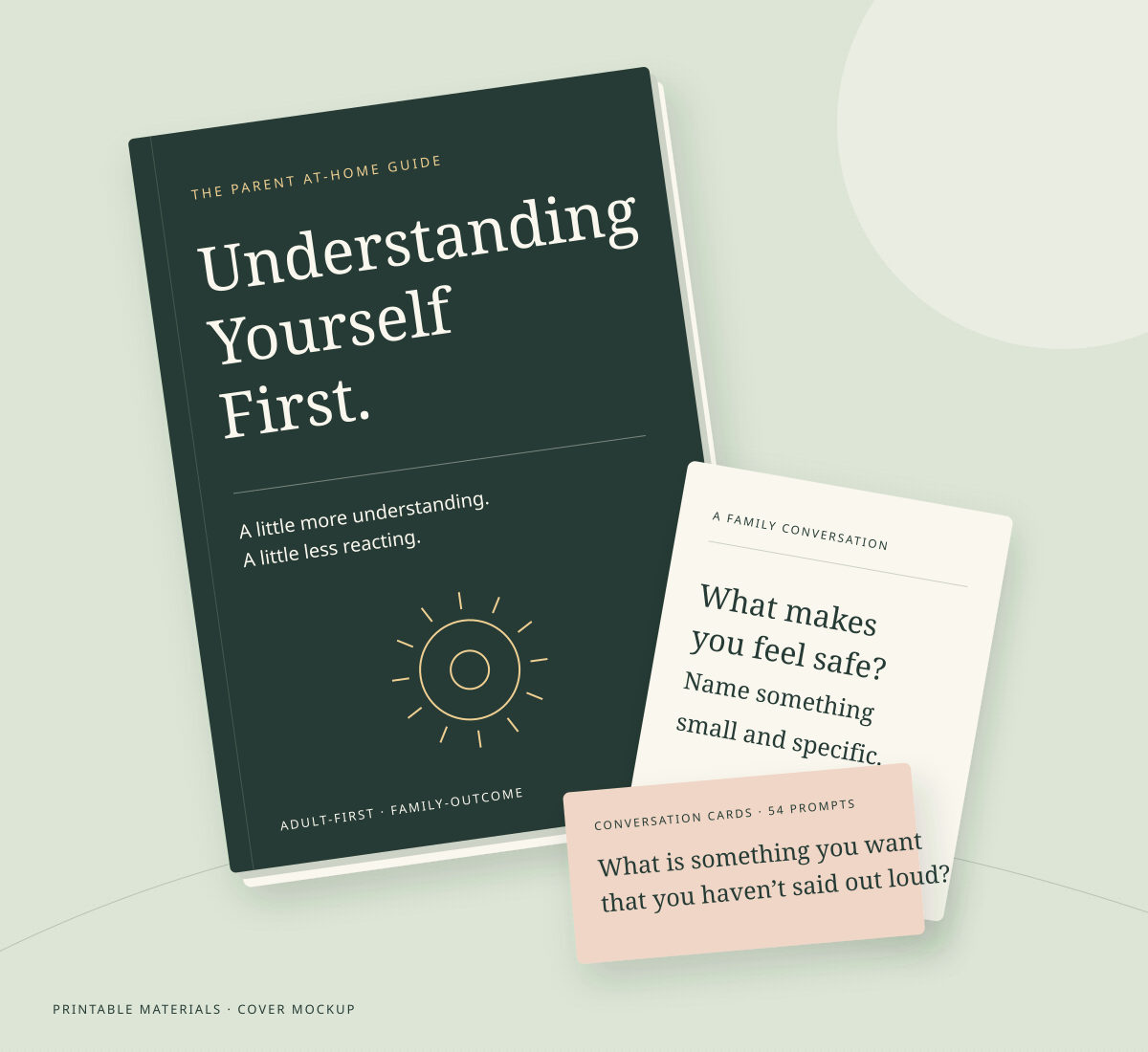
Product preview of Understanding Yourself First with printable family conversation cards
Digital materials. Print them, or read at your own pace.
The author behind the approach

Meet Sarah Dutton Waxman.

Sarah is a former educator of 10 years and a certified Enneagram coach. Her adult-first thesis invites you to understand yourself first so you can understand the child in front of you.

“A better you is a better them.”

— Sarah Dutton Waxman

Visit Sarah’s website

The Student Enneagram: The Secret to Leveling-Up Our Kids at Home & in the Classroom

Sarah’s book helps adults become self-aware so they can understand their children and students through observation of behavior, rather than diagnosis or labeling of a child.

This program’s parent guide and conversation cards bring that adult-first thesis into everyday family life. Our never-type-minors rule consistently extends it: we never assess, number, or label a child.

Published July 19, 2022 by That's A Big Idea, LLC · 180 pages
ISBN-13: 979-8986471402 · ASIN: B0B6SDX5ZF

Get the book

More from Sarah — The Student Enneagram, the print book behind these materials. Adult-first, never a child label.

Get the book on Amazon
Made for real life at home

The work begins with you.

The guide explores how your own motivations and fears can shape the way you parent. You’re invited to notice yourself, rather than decide who your child is.

Read the pattern that makes you pause. Try an experiment. Ask an honest question and let the answer stand.

Our promise: children are never typed or labeled.

In your digital download

  • Nine chapters about adult patterns at home
  • Bedtime, homework, discipline, conflict, mealtime, and screens
  • Three small experiments in every type chapter
  • A 30-day practice for noticing your own reactions
  • All 54 printable family conversation cards

No account, workshop, or coaching call required. The $19 adult instrument is a separate product.

Read before you decide

Recognize yourself in the pages.

Two full adult-pattern chapters, pulled directly from the guide. Every “you” below is the parent.

Chapter 2: Type 1, The Reformer

If this is you

You notice the crooked picture frame before anyone else does. You straighten it without being asked. You have a running list in your head of the way things should be done, and it is a good list. When the house is calm and things are in their place, you can finally exhale. When they are not, you feel a low hum of irritation that you usually do not name out loud.

You are the parent who says "we do not say it that way" and "that is not where that goes." You are fair, genuinely fair, and you work hard to be consistent. The word you would use for yourself is responsible. The word you would use for your own inner weather is tense.

The core of Type 1

The core motivation is to be good, to have integrity, to be right and to live without blame. The core fear is of being corrupt, defective, or bad.

In the established literature this type is called the Reformer: principled, purposeful, self-controlled, perfectionistic (Riso-Hudson, https://www.enneagraminstitute.com/type-descriptions/). Claudio Naranjo described the type's passion as anger, specifically a resentment about how things fall short of the standard, held in check and turned into correction (Naranjo, Character and Neurosis, 1994). David Daniels framed the type's gift as the capacity for principled, disciplined goodness (Daniels and Price, The Essential Enneagram).

How this shows up at home

  • Bedtime. You have a routine and it matters. When the routine slips, you feel it as a failure of the evening, not just a late bedtime.
  • Homework. You want it done, done right, and done before the fun. A rushed or sloppy worksheet bothers you more than it bothers the child.
  • Discipline. You correct with precision. You explain the rule, the violation, and the consequence, and you are almost always right about all three.
  • Sibling conflict. You want the wrongdoer identified and the record set straight. Justice matters to you more than peace.
  • Mealtime. Manners, elbows off the table, and the vegetables are not small things to you. They are the daily practice of doing life correctly.
  • Screens. You notice the minutes over the limit. You notice the app that is not on the approved list. Rules are rules.

The trap

The trap is that your child learns that being good means being error-free, and that your love feels most present when they perform to the standard. The inner critic that runs you gets aimed, gently and without malice, at them. A child who grows up under a constant, loving audit can stop trying things they might get wrong, because wrong feels too expensive. Your standard is high because you want them to be good. They may hear it as: you are never quite good enough.

What your kid experiences

A child in your house experiences a parent who is steady, fair, and predictable, and also a parent who can seem to be grading the day. They may feel safe because you are consistent, and tight because nothing is ever fully done. They learn to read your face for the small sigh that means something fell short.

Three things to try this week

  1. Let one small thing stay wrong on purpose. Leave the crooked frame. Notice what happens in your body and say nothing about it.
  2. When you correct, start with one true sentence about effort before the sentence about error. "You worked hard on this" before "but you missed number four."
  3. Once this week, at bedtime, name one thing you got wrong today in front of your child, out loud, with no self-punishment attached.

What the other types see in you

They see integrity and reliability, a parent whose yes means yes. They also see a standard that can feel like a temperature in the room. The more relaxed types may feel they are failing you without knowing the rule. A soft word from you about "good enough today" goes a long way with them.


Chapter 3: Type 2, The Helper

If this is you

You know what everyone needs before they ask. You are already up getting the water. You are the parent who anticipates, who remembers the favorite snack, who notices the mood shift across the room before the child does. Helping is not something you do. It is how you know you matter.

And somewhere underneath, there is a quiet scorecard. You give and give, and on a hard day you notice that no one is giving back, and it stings in a way you are not proud of.

The core of Type 2

The core motivation is to feel loved and wanted. The core fear is of being unwanted, unneeded, or unworthy of love.

Riso-Hudson call this type the Helper: generous, demonstrative, people-pleasing, and at the unhealthy end, possessive (https://www.enneagraminstitute.com/type-descriptions/). Naranjo named the type's passion as pride, the quiet belief that one is needed and that one's love is the thing holding others up (Naranjo, Character and Neurosis, 1994). Daniels described the type's gift as warmth and the capacity for genuine care (Daniels and Price, The Essential Enneagram).

How this shows up at home

  • Bedtime. You stay for the extra story, the extra hug, the one more question, because leaving feels like abandoning.
  • Homework. You hover with help. You are tempted to do the task with them, because helping feels like love.
  • Discipline. You struggle to hold a consequence. Saying no feels like withdrawing love, so you soften it, then feel resentful when the behavior repeats.
  • Sibling conflict. You rush to comfort the one who is crying, and may accidentally teach the others that tears are how you earn your attention.
  • Mealtime. You cook to please, and you notice who ate what, and a pushed-away plate can feel like a personal verdict.
  • Screens. You give extra time because the child asked sweetly, then feel used later and do not say why.

The trap

The trap is that your help becomes the currency, and the child learns that love is something you earn by needing the parent. You teach them to look to you for their worth instead of finding it in themselves. And because you never ask for what you need, your own tank drains until you are running on fumes and calling it service.

What your kid experiences

A child in your house experiences deep warmth and attention, and also a subtle pressure to stay dependent enough to be helped. They may learn that their needs are welcome, but that their independence makes you anxious. They may also learn, by watching you, that asking for what you want is somehow not allowed.

Three things to try this week

  1. Once this week, let someone struggle for a full minute before you step in. Count the minute in your head.
  2. Say one true "I need" out loud to your family, something you would normally skip. "I need ten quiet minutes before dinner."
  3. When your child asks for help, ask back: "What do you already know how to do?" and wait for the answer before you move.

What the other types see in you

They see a warm, generous parent who makes home feel attended to. They also see, over time, that you do not take in what you give, and that you may be keeping a ledger no one agreed to. The more independent types may feel crowded by your help and not know how to say so kindly. Hearing "I've got this" from them is not rejection. It is trust.


Your starting point for home

Read. Notice. Try one change.

The $29 guide includes all 54 cards. You can start with the adult-pattern chapters; you do not need to buy an instrument first.

Want scored prompts for your own reflection? The optional $19 adult instrument complements the guide. Buying both costs $48 in two separate purchases at their regular prices.

Preview the conversation cards. A child never takes an assessment or receives a number.

Also teach? See the Teacher Starter Kit for your classroom.

Parent Guide + Cards

$29 one-time purchase

Digital download · Personal household use · No recurring charge

Purchase terms · Never type minors

Keep noticing

A little space to reflect.

Join the parent newsletter for adult self-reflection and ideas for home. Adult email addresses only.